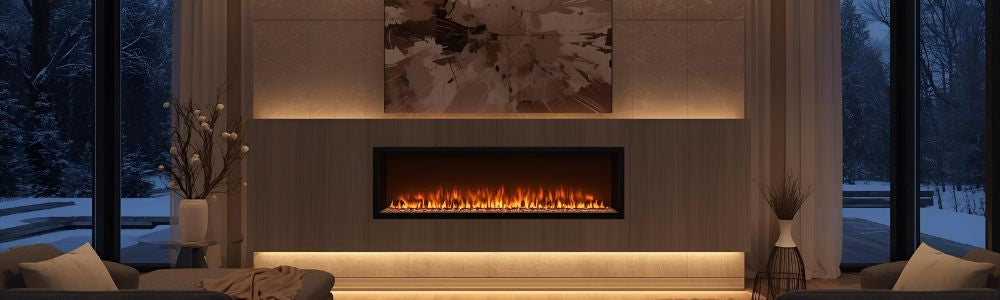
An electric fireplace can add visual warmth, supplemental heat, or a completely new focal point to a room. But the best choice is not always the biggest model or the one with the longest feature list. It is the fireplace that fits your space, installation plan, daily routine, and design style.
Before you compare colors and prices, answer these seven questions. They will help you narrow the options and avoid the most common buying mistakes.
1. Which Type of Electric Fireplace Fits Your Room?
Electric fireplaces come in several forms, and each solves a different design problem.
Recessed or wall-mounted fireplaces

A linear recessed fireplace creates a built-in look for a modern feature wall. Wall mounting can deliver a similar visual effect with less wall construction. These models work especially well in living rooms, bedrooms, offices, and media spaces.
Best for: modern rooms, horizontal focal points, and shoppers who want adjustable flame effects.
View an ultra-thin recessed and wall-mounted electric fireplace
Fireplace inserts

An insert is designed to fit into a compatible opening or surround. It can be a practical choice when updating an existing fireplace area or building a custom cabinet or wall feature.
Best for: renovation projects and existing fireplace openings—after exact measurements are confirmed.
View a 36/39 inch electric fireplace insert
Electric log sets

A log set places glowing logs and flame effects inside a suitable existing fireplace opening. It changes the look of an unused firebox without requiring a full linear unit or mantel package.
Best for: homeowners who already have a fireplace opening and want a simple visual update.
View a 20 inch electric fireplace log heater
Mantel fireplace packages

A mantel package combines an electric firebox with a furniture-style surround. It creates a traditional focal point without requiring a recessed wall cavity.
Best for: renters, traditional rooms, and anyone who wants a complete fireplace look in one coordinated piece.
View a 43 inch electric fireplace mantel package
Freestanding fireplace stoves

Freestanding stoves offer a compact, classic shape and can be placed without building a surround. Placement must still follow the product manual and electrical requirements.
Best for: smaller rooms, flexible layouts, and traditional or cottage-inspired interiors.
View a 24 inch freestanding electric fireplace stove
Browse the R.W.FLAME electric fireplace collection to compare these product types side by side.
2. Have You Measured the Entire Installation Area?

The size in a product title usually describes its nominal width, not every installation dimension. Before ordering, record:
- Available wall or opening width
- Available height and depth
- Distance to doors, windows, trim, shelves, and furniture
- Outlet location and cord-routing options
- The position of wall studs or other structural support
- Required ventilation and safety clearances
- Package dimensions if the delivery route is narrow
For a recessed installation, use the cutout and clearance information for the exact model and size. Do not assume that two fireplaces with the same advertised width require the same wall depth or opening.
For a mantel package, measure the full outside width and depth—not only the firebox. Also check the path from the entrance to the final room, including doorways, stairs, and tight corners.
A simple paper or painter’s-tape outline on the wall can help you judge scale before buying.
3. Are You Buying Primarily for Heat, Ambiance, or Both?

Some shoppers want supplemental warmth. Others mainly want the look of a flame throughout the year. Knowing your priority helps you focus on the right specifications.
Many models in the R.W.FLAME collection offer two heating settings, commonly 750W and 1500W, but heating output and controls vary by product. Always confirm the exact listing rather than assuming every fireplace uses the same settings.
When comparing heating features, look for:
- Available wattage or heat settings
- Adjustable temperature controls
- Timer duration
- Whether flame and heat can operate independently
- Overheat protection
- Recommended room use on the specific product page
An electric fireplace should generally be treated as supplemental zone heating rather than a replacement for a whole-home heating system. Performance will also depend on room insulation, ceiling height, exterior temperature, doors, windows, and airflow.
If ambiance is your priority, focus more on flame color, brightness, speed, ember-bed design, logs or crystals, and whether the flame effect can run without heat.
4. Which Controls Will You Actually Use?

More control options are useful only when they match your routine.
Panel controls
A built-in panel is dependable and always available at the unit. It is useful when a remote is misplaced or when you want a quick manual adjustment.
Remote control
A remote is convenient for changing heat, flame, or timer settings from a sofa or bed. Check which functions are available from the remote; they may not be identical on every model.
App and voice control
Connected models can add mobile-app operation and compatibility with supported voice assistants. These features are useful for smart-home routines or for controlling the fireplace without reaching for the remote.
Before choosing a smart model, confirm:
- Supported app and voice platforms
- Home Wi-Fi requirements
- Which functions can be controlled remotely
- Whether manual panel and remote controls remain available
If you prefer simple, offline operation, a panel-and-remote model may be the better choice. If the fireplace will be part of a connected home, smart control may be worth the upgrade.
5. What Flame Style Matches Your Interior?
Flame design affects how the fireplace feels even when the heater is off.
For a modern room, a long linear flame with crystals or a colored ember bed can complement clean furniture and wide feature walls. For a traditional room, logs, warm amber flames, and a mantel surround often create a more familiar fireplace appearance.
Useful customization features may include:
- Flame color choices
- Ember-bed or flame-bed colors
- Brightness settings
- Flame-speed settings
- Crystal and log media
- Simulated crackling sounds
Think about how the fireplace will look in daylight as well as at night. Bright multicolor effects can be dramatic, while lower amber settings may feel calmer for everyday use. The most versatile models allow you to switch between both.
6. Is the Planned Location Safe and Practical?

A fireplace should fit the room visually without compromising ventilation, access, or safe operation.
Before installation:
- Read the manual for the exact model and size.
- Keep air inlets and outlets unobstructed.
- Follow all required distances from furniture, curtains, bedding, and other materials.
- Confirm that the electrical supply matches the product requirements.
- Do not use an extension cord unless the manufacturer explicitly permits it.
- Make sure mounting hardware is secured to appropriate structural support.
- Follow local electrical and building codes.
If the fireplace will be installed below a television, shelf, or other heat-sensitive item, follow the clearance and placement instructions for both products. Do not rely on a photograph alone to determine safe spacing.
Professional installation is a sensible choice whenever the project involves wall modification, uncertain structural support, new electrical work, or local code requirements.
7. What Will Ownership Look Like After Installation?

Electric fireplaces typically require less routine maintenance than wood-burning fireplaces, but they still benefit from basic care.
A practical maintenance routine includes:
- Turning off and unplugging the unit before cleaning, when permitted by the manual
- Dusting accessible vents without pushing debris inside
- Cleaning the glass or front panel with an approved soft cloth
- Keeping the air path clear
- Checking the cord, plug, mounting, and surrounding wall periodically
- Storing the remote and manual in an easy-to-find place
Before buying, also review the current warranty, return policy, replacement-part availability, and customer-support information. Policies can change, so use the latest pages on the website rather than relying on an old advertisement or third-party listing.
Quick Decision Guide
| Your Priority | Product Type to Explore First |
|---|---|
| A clean, modern feature wall | Recessed or wall-mounted linear fireplace |
| Updating an existing opening | Fireplace insert or electric log set |
| A complete traditional focal point | Mantel fireplace package |
| A compact classic look | Freestanding fireplace stove |
| The shallowest wall profile | Ultra-thin recessed/wall-mounted model |
| App and voice control | Smart recessed/wall-mounted model |
| Simple physical controls | Panel-and-remote model |
| Year-round visual ambiance | A model with flame-only operation |
Final Checklist Before Checkout
Before placing your order, confirm all of the following:
- Product type fits the room and installation plan
- Exact width, height, and depth fit the available space
- Recessed opening or mounting requirements are understood
- Delivery package can reach the room
- Electrical requirements are available at the installation point
- Heating settings match your intended use
- Flame, media, sound, and control features match your preferences
- Required clearances can be maintained
- Current warranty, shipping, and return terms have been reviewed
A few minutes spent on these checks can prevent an expensive mismatch and make installation much smoother.
Choose for Your Space, Not Just the Specification List
The right electric fireplace should feel intentional in the room. A slim linear model can make a modern wall feel complete; an insert can renew an existing fireplace opening; a log set can add life to an unused firebox; and a mantel package can create an instant traditional centerpiece.
Start with the room, measure carefully, decide how much heat and control you need, and then compare models within the product type that fits your plan. That approach is more reliable than choosing by width, price, or feature count alone.